Due July 6, 2026

The Hiroshima Peace Institute for Research and Education (HPI), in which Hiroshima University participates, aims to contribute to the creation and maintenance of world peace as well as the development of local communities.
As part of this mission, HPI has established the “HPP Fellowship,” a short-term stay program that invites internationally active early-career researchers in peace studies and related fields to conduct research at Hiroshima University or Hiroshima City University.
The call for applications for this program has now opened. For details, please refer to the information provided here: Hiroshima Peace Institute Fellowship.
The University of Seoul (UOS) in South Korea is offering SMU students a chance to participate in a 3-week Summer Program!
Program Venue
University of Seoul, Seoul, South Korea
Program Theme/Name
Seoul International Summer School II (SISS II) 2026
Program objectives and options
This short-term academic and cultural program features special lectures on contemporary Korean topics alongside structured Korean language courses.
■ Course Information (taught in English, 3credits, 45 class hours)
• Korean Studies: Six special lectures on topics such as K-Pop, Korean drama and film, mass media
• Korean Language: Level-based Korean language classes
■ Cultural Activities:
• Field trip
• Welcome & farewell parties
• “Design Your Own Seoul” days (including a three-day free-pass ticket)
• Interaction with Korean Peer Advocates (PAs)
Upon successful completion of the program, a certificate of completion will be issued by early September.
Eligibility/Language Requirements
This program is open to students enrolled at SMU as undergraduate and graduate students for the duration of the program in good standing who will have completed 1 year of Bachelor studies by the end of Winter 2026. Applicants must have a passport that remains valid for at least 6 months.
Language of instruction
The program is delivered in English.
Program website
Please visit https://oia.uos.ac.kr/oia/web/contents/OIA_Studyat_05_01.
Dates:
August 5 – August 21, 2026 (3 weeks)
Program Fee
1,700,000 KRW (approx. CAD$1600)
The program fee includes registration fee and tuition (including field trips and on-campus housing).
Students are additionally responsible for meals, airfare, insurance, local transportation between the university and accommodation, and daily expenses. A $100 SMU Study abroad admin fee will be charged on banner.
If academic credits are earned, students will not be assessed a separate SMU tuition at SMU for the transfer credit hours.
Canadian passport holders and those who hold citizenship from countries eligible for a visa-free entry may enter Korea without a visa for the duration of the program. If a visa is required, the host university will provide the necessary supporting documents (note: please consider the costs of applying for a visa; it may be necessary for those who need a visa to travel to a Consular affairs office of the Korean government in another Canadian city to apply in person, so budget accordingly). Please see the Immigration section below.
Transfer credits:
Students may be able to earn credits to the extent that those credits are applicable to the program requirements of your SMU degree. Please meet with your academic advisor of your program (visit https://www.smu.ca/academics/academic-advising.html) to see if any of your remaining degree requirements can be completed at another university. If your advisor confirms that there is room for credits from another institution in your degree requirements, you will request approval to take courses for transfer credits by submitting a Letter of Permission Request Form (found at https://www.smu.ca/academics/student-forms.html) and course descriptions to the SMU Academic Advising Office as soon as your acceptance is confirmed.
Alternatively, if not transferring credits, you may receive recognition for extra-curricular experiences through the Co-Curricular Record (see here).
Funding
Limited funding ($500 on average) may be available. Students who are accepted to the program will be invited to request funding.
Immigration:
Citizens of certain countries are required to apply for a visa before entering Korea, while visas are waived for others. Questions related to immigration should be directed to the Consulate General of the Republic of Korea in Montreal (see https://www.mofa.go.kr/ca-en/wpge/m_5237/contents.do).
Number of SMU students accepted:
3
How to apply:
Interested students should submit the SMU Exchange Program application* by May 15 2026 to the Global Learning Office.
*To complete your application, you will:
fill out your Study Abroad Application (https://studio.smu.ca/s/StudyAbroadApplication2021.pdf)
write a one-page letter of intent. (Tip: book an appointment with The Writing Centre once you have a draft https://studio.smu.ca/wc-student-tutoring)
print (in pdf) your unofficial transcript from banner
prepare your resume, and
secure two references (one must be from a SMU professor of one of your courses) – referees can email their letters directly to Global@smu.ca. Inquiries can be sent to Miyuki.arai@smu.ca.
Once you have all four pieces of application documents (except for references), upload them at the application link here https://smuniversity.qualtrics.com/jfe/form/SV_55UpfboKu5sImUe.
What happens after you apply?
Once your application package is received, the Global Learning Office will be in touch to schedule a short interview. If you are selected, 1) you will be nominated to the host university by the SMU Global Learning Office and 2) you will be instructed to complete a set of applications for the host university by early June. Once the host university accepts you into the program, they will provide all program-related information as well as instruction for the payment of the program fee. You will also be expected to attend our pre-departure orientation meetings. You will arrange your own international travel.
Questions?
Email the Global Learning Office (Global@smu.ca or Miyuki.arai@smu.ca).
The Mitacs Globalink Research Internship (GRI) faculty call for Summer 2027 will be opening soon!
GRI connects professors in Canada with top senior international undergraduate students for 12-week, full-time research internships taking place between May and October 2027.
The Globalink program builds international networks and positions Canada as a top research and innovation destination for emerging talent around the world.
All disciplines are eligible. We especially encourage faculty working in quantum science and technology to submit their projects
Top-ranked senior undergrads travel from around the world
Faculty can submit multiple projects
Re-submit projects from previous years by using the clone option on the platform
If you are interested in hosting an intern or would like to be notified when the faculty call opens, we invite you to register your interest using the link below:
Register your interest
To be eligible to host interns as part of the Globalink Research Internship program, you must:
Have one of the following statuses at an eligible institution: Full professor, Associate professor, Assistant professor, Adjunct professor, Emeritus professor
Be able to supervise international students at your institution
Be able to host interns within the stipulated dates of the GRI program: Internships must start between May 1 and July 31 and must be delivered over the course of 12 consecutive weeks
Additional details and application instructions will be shared when the call officially launches.
NEOMA Business School is inviting Saint Mary’s students to their Summer Short Program!
These programs offer students the opportunity to study in an international environment, earn credits (pending approval of SMU academic advisors), and enjoy an immersive academic and cultural experience in France.
Courses offered:
Venture Studio Bootcamp – Experience entrepreneurship like never before!
June 8th – June 19th, 2026
Credits: 9 ECTS
Location: Paris & Rouen, France
Activity fees payable to the host university: €900
Sport Federations & Major Events Management
June 29th – July 18th, 2026
Credits: 12 ECTS
Location: Paris & Reims, France
Activity fees payable to the host university: €1,200
A Summer in Paris – Study from 1 to 4 weeks in Paris!
July 6th – July 31st, 2026
Week 1 (July 6-10): Cross-Cultural Management 1: Intercultural Communication
Week 2 (July 13-17): Strategy & Sustainability
Week 3 (July 20-24): Luxury Marketing
Week 4 (July 27-31): International Finance: The European Perspective
Credits: Up to 24 ECTS (6ECTS per course)
Location: Paris, France
You will find additional details in the attached brochure.
Eligibility: Successful completion of at least one year of undergraduate-level studies.
Credits:
See above. Typically, 3credit hours at SMU is earned for each 6 ECTS credits given at European partner schools. However, discuss the course detail with your academic advisor so that they can review the instructional hours, learning outcomes, etc. to determine if SMU credits can be considered.
Language: English
Number of students accepted from SMU: 3
Fees
SMU students pay normal SMU tuition for the transfer credit hours at SMU. In addition, students will pay the activity fee as listed above at the host university.
Travel, accommodation, travel insurance, immigration application costs (if applicable), meals, local transportation, personal expenses, etc. are also each participating student’s responsibility. A $100 SMU Study abroad admin fee will be charged on banner.
Canadian passport holders and those who hold citizenship from countries eligible for a visa-free entry may enter France without a visa for the duration of the program. If a visa is required, the host university will provide the necessary supporting documents for your visa application. Note: please consider the costs of applying for a visa; it may be necessary for those who need a visa to travel to a visa processing centre in another Canadian city to apply in person, so budget accordingly. Please see the Immigration section below.
Transfer credits
Students may be able to earn credits to the extent that those credits are applicable to the program requirements of their SMU degree. Meet with your academic advisor of your program ( https://www.smu.ca/academics/academic-advising.html) to see if any of your remaining degree requirements can be completed at another university. If your advisor confirms that there is room for transfer credits in your degree, you will request approval to take courses for transfer credits by submitting a Letter of Permission Request Form (found here https://www.smu.ca/academics/student-forms.html) and course descriptions to the SMU Academic Advising Office as soon as your acceptance is confirmed.
Funding
Limited funding ($500 on average) may be available. Students who are accepted to the program will be invited to request funding.
Immigration:
Citizens of certain countries are required to apply for a visa before entering Finland, while visas are waived for others. Questions related to immigration should be directed to the French government’s France-Visas website (https://france-visas.gouv.fr/en-US/web/france-visas/) and VFS Global (https://visa.vfsglobal.com/can/en/fra/).
How to apply
Interested students should submit the SMU Exchange Program application* by March 15 2026 for all other courses to the Global Learning Office.
*To complete your application, you will:
fill out your Study Abroad Application (https://studio.smu.ca/s/StudyAbroadApplication2021.pdf)
write a one-page letter of intent. (Tip: book an appointment with The Writing Centre or ask if personal statement workshops are coming up https://studio.smu.ca/wc-student-tutoring)
print in pdf your unofficial transcript from banner
prepare your resume, and
secure two references (one must be from a SMU professor of one of your courses) – referees can email their letters directly to Global@smu.ca. Alternatively, they can email Miyuki.arai@smu.ca to inquire.
Once you have all four pieces of application documents (except for references), upload them at the application link here https://smuniversity.qualtrics.com/jfe/form/SV_55UpfboKu5sImUe.
What happens after you apply?
Once your application package is received, the Global Learning Office will be in touch to schedule a short interview. If you are selected, 1) you will be nominated to the host university by the SMU Global Learning Office and 2) you will be instructed to complete a set of applications for the host university by the end of March. Once the host university accepts you into the program, they will provide all program-related information as well as instruction for the payment of the program fee where applicable. You will also be expected to attend our pre-departure orientation meetings.
Questions?
Email the Global Learning Office (Global@smu.ca or Miyuki.arai@smu.ca).
Welcome to the world of opportunities!
Thank you for your interest in SMU Exchange! While you prepare your application, you may want to learn in advance what your (and the Global Learning Office’s) plans, expectations, and responsibilities are. This information guide will help you prepare for a well-planned exchange program. Please review this guide carefully and thoroughly so that your application is full and complete for the selection process. And remember, we are here to assist you throughout all phases of the exchange program! Please e-mail Miyuki.arai@smu.ca if you have any questions or concerns.
Why should I study abroad?
There are many reasons and benefits. When you study abroad, you not only enrich your academic experience but also develop intercultural communication skills, competencies and confidence. It is a once-in-a-lifetime experience through which you build your resume, learn about different cultures, and make new friends from around the world. Besides you have the support of the home and host universities throughout the journey.
What are the semester dates in Finland?
Autumn semester: September-December (orientation program in late August)
Spring semester: January-May (orientation program in the beginning of January)
Is there funding?
Yes! The funding program is called the “Erasmus+” International Credit Mobility. Read on below.
What is LUT University like?
LUT University was founded in 1969 and is one of the top-ranked higher education institutions in Finland. LUT University describes themselves as, “We are trailblazers in promoting the energy transition and the regenerative use of natural resources, and we help build resilient communities, industry, and businesses through data, research, and education.” (see more here). LUT University welcomes every year around 200 exchange students to its Lappeenranta campus located by beautiful Lake Saimaa only two-hour train ride away from the capital Helsinki. The population of Lappeenranta is 73,000 inhabitants. See more information about Lappeenranta here. SMU and LUT have been exchange partners since 2005.
LUT University offers exchange studies for selected study fields at the Lahti campus in Lahti, even closer to the capital area. The population of Lahti is approximately 122,000 inhabitants.
What subjects are offered at LUT University? In what language?
Fields of study for exchange students, many of which are in English, at the Lappeenranta campus include:
Business (Business Administration)
Technology (Chemical Engineering, Computational Engineering, Electrical Engineering, Energy Technology, Environmental Technology, Industrial Engineering and Management, Mechanical Engineering, Software Engineering (only Master)
Social Sciences (Social Sciences, Communication Sciences)
Fields of study for exchange students, many of which are in English, at the Lahti campus include:
Industrial Engineering and Management (only Bachelor)
Software Engineering (Bachelor and Master)
See more information about LUT University courses for exchange students here.
Successful students can receive a grant of €5,688 (approx. CAD$9200) for 5months of exchange study at LUT.
Number of grants available for AY2026-27: 3
Three (3) successful applicants will be selected for the LUT exchange program, and those three students will receive an Erasmus+ mobility grant each. Each grant consists of 900euro-stipend per month for 5 months plus a travel subsidy of 1,188euros for a total of 5,688euros. Funding will be given by LUT after students arrive in Finland; therefore, students need to pay out of pocket any upfront expenses such as the residence permit application costs and international airfare. Top up grant for participants with fewer opportunities where available.
Can I receive transfer credits towards my SMU degree?
It depends on which courses you have left to complete for your SMU degree. Please meet with your academic advisor (see here) as a first step. Your advisor will not be able to tell you which courses to take (-- it is up to you to research the partner university’s courses) but can 1) confirm if any of the remaining SMU program requirements can be completed abroad during the exchange program and 2) go over the Letter of Permission process with you.
Note: LUT course credits are weighted differently from SMU courses. If you plan to earn 15 credit hours from the exchange semester towards your degree, you should aim to validate 30 “ECTS” credits at LUT.
You must attain a grade of C or higher in most cases for the host university credits to be accepted by SMU. Please note that the host university’s grades will not be used in the calculation of your SMU GPA – the transfer credits will show on your SMU transcript with a code, “TR”, instead of a letter grade.
What did former exchange students say about studying in Finland?
Watch Caitlin’s testimonial here! Caitlin studied in Finland for a semester in the 2022-23 academic year.
Am I eligible?
The Exchange Program is open to all SMU students (Canadian and Non-Canadian students, full-time or part-time) who are in good academic standing and have completed at least 30 credit hours at SMU. We welcome applicants of diverse backgrounds and abilities. Students who are eligible to receive transfer credits towards their SMU degree will be prioritized.
Important: Your official transcript will be sent from the host university upon completion of the exchange program; however, it will take a couple of months for the transfer credits to be added to your banner account. Therefore, if you are in your final year of your Bachelor program, please discuss your graduation timeline with the academic advising office.

What are my costs?
You will be responsible for SMU tuition (paid at SMU for the transfer credit hours), $100 study abroad admin fee, international and in-country travel, travel insurance, housing, food, communication, passport application, Finnish immigration* application, any fees charged by the host university and miscellaneous/personal expenses.
The average living expenses for a single student in Finland amount to about €700-900 (approx. CAD$1150-$1500) per month.
Do I need a visa to study in Finland?
Yes. Exchange students need to obtain a “Residence Permit” to study in Finland. The Residence Permit application process begins as soon as your acceptance letter is issued by the host university. Students need to prove that they have 800euros per study month. Important: After completing an electronic application, all applicants must visit a VFS Global application centre in person to prove their identity, NO EXCEPTIONS. For students in Nova Scotia, the closest VFS Centres to Halifax are in Montreal or Ottawa. Budget for your travel to a VFS Centre accordingly. See more information at:
Guide for students applying for a residence permit here
How to apply for a residence permit provided by the Finnish mission in Canada here
The VFS.GLOBAL Finland Residence Permit Application Centres here
How do I apply? When is the application deadline?
You will submit your application for the Erasmus+ Finland exchange program (Fall 2026 and Winter 2027) to the SMU Global Learning Office by March 2 2026 at 4pm*.
To complete your application, you will:
fill out your Study Abroad Application (https://studio.smu.ca/s/StudyAbroadApplication2021.pdf)
write a one-page letter of intent. (Tip: book an appointment with The Writing Centre once you have a draft https://studio.smu.ca/wc-student-tutoring)
print (in pdf) your unofficial transcript from banner
prepare your resume, and
secure two references (one must be from a SMU professor of one of your courses) – referees can email their letters directly to Global@smu.ca. Inquiries can be sent to Miyuki.arai@smu.ca.
Once you have all four pieces of application documents (except for references), upload them at the application link here https://smuniversity.qualtrics.com/jfe/form/SV_55UpfboKu5sImUe.
*If not all grants are allocated after the selection process, applications will continue to be accepted for the Winter 2027 exchange program on a first-come, first-served basis up to 4pm on August 31 2026.
What happens after you apply?
Once your application package is received, the Global Learning Office will be in touch to schedule a short interview. If you are selected, 1) you will be nominated to the host university as SMU’s Erasmus+ credit mobility grant recipients by the SMU Global Learning Office and 2) you will be instructed to complete a set of applications for the host university by late April (Fall Exchange Program) or by late September (Winter Exchange Program). Once the host university accepts you into the program, you will be provided with all program-related information.
As soon as your acceptance is confirmed by the host university, you will start the Residence Permit application process with VFS Global.
You will arrange your own international travel.
You will also be expected to attend our pre-departure orientation meetings at SMU. The host university will also organize a mandatory orientation program at the beginning of the exchange semester.
From Acceptance to Pre-departure
Once you are accepted into the program by SMU and by the host university, there are other steps you will follow to prepare for your departure. Those steps include the following and additional information about each item will be provided later:
Request approval for taking host university courses for the transfer of credits (via a Letter of Permission Request Form)
Apply for a passport within 6 months of the expected end date of the exchange program.
If you are a non-Canadian student, ensure your Canadian Study Permit and Visa remain valid for re-entry to Canada after the exchange program. (If you are a Canadian Permanent Resident Card holder, check the expiry date, too.)
Apply for a Finnish Residence Permit
Arrange travel insurance (mandatory)
Purchase airline tickets
Attend pre-departure briefing meetings and learn to manage travel risks
Register in courses at the host university
Apply for housing as directed by the host university
Get to know other SMU students who will be on exchange in the same semester
Inform the Global Learning Office if applying for a student loan, and keep in touch with the SMU Financial Aid & Awards Office
Research the host country and region
Request accessibility services to the host university, as required
Register your travel
Complete the waiver form
Attend the orientation at the host university (mandatory)
Pay SMU tuition and $100 fee at SMU
Review the post-experience reporting requirements and book a re-entry workshop
Receive an official transcript from the host university so your credits will be added to banner
If there are any questions or concerns, email Miyuki.arai@smu.ca.
We look forward to receiving your application!
Contact Information:
Miyuki Arai, Global Learning and Intercultural Support
Email: Miyuki.arai@smu.ca
Office: Atrium 106
Welcome to the world of opportunities!
Thank you for your interest in SMU Exchange! While you prepare your application, you may want to learn in advance what your (and the Global Learning Office’s) plans, expectations, and responsibilities are. This information guide will help you prepare for a well-planned exchange program. Please review this guide carefully and thoroughly so that your application is full and complete for the selection process. And remember, we are here to assist you throughout all phases of the exchange program! Please e-mail Miyuki.arai@smu.ca if you have any questions or concerns.
Why should I study abroad?
There are many reasons and benefits. When you study abroad, you not only enrich your academic experience but also develop intercultural communication skills, competencies and confidence. It is a once-in-a-lifetime experience through which you build your resume, learn about different cultures, and make new friends from around the world. Besides you have the support of the home and host universities throughout the journey.
What are the semester dates in Finland?
Autumn semester: September-December (orientation program in late August)
Spring semester: January-May (orientation program in the beginning of January)
Is there funding?
Yes! The funding program is called the “Erasmus+” International Credit Mobility. Read on below.
What is University of Jyväskylä like?
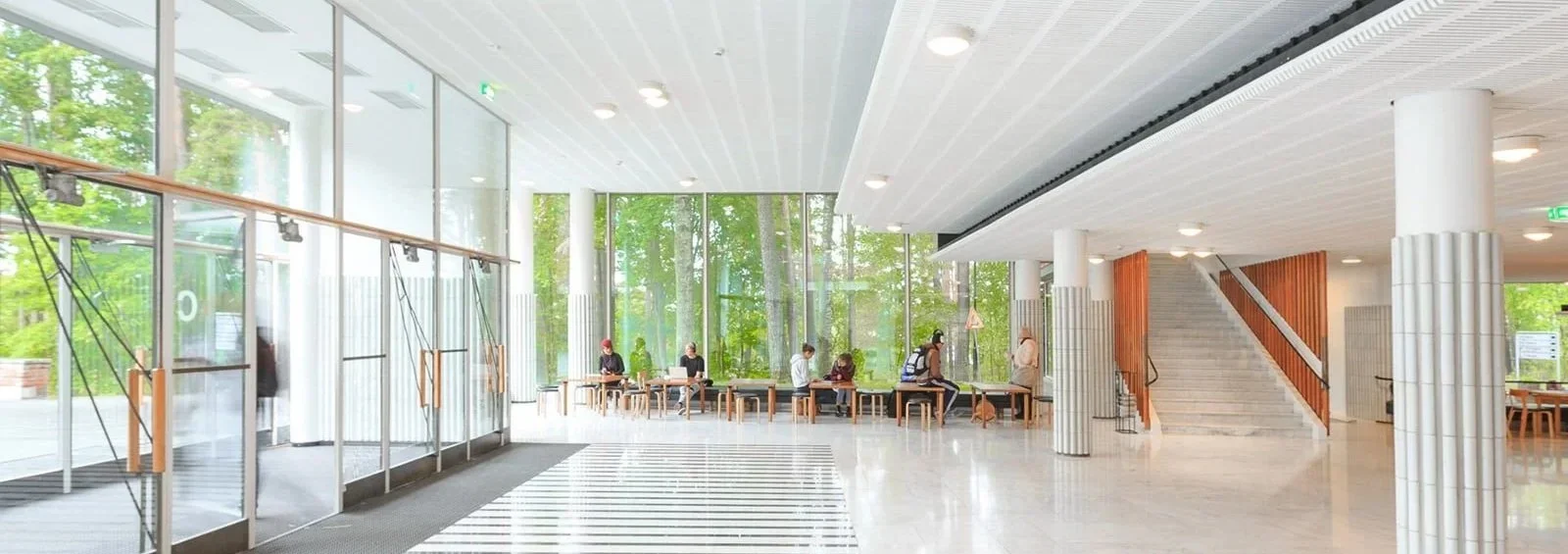
University of Jyväskylä (JYU) is an internationally ranked research university and is one of the largest and most popular multidisciplinary universities in Finland. JYU provides a genuinely supportive and enjoyable environment for studying. JYU has 14 300 students from about 100 countries. They believe that interaction with people from different cultures and backgrounds is an essential part of academic studies and the university experience. The population of Jyväskylä is around 148,000, and the city is located about 170km north of the capital city, Helsinki. See more information about Jyväskylä here. SMU and JYU have been exchange partners since 2006.
What subjects are offered at JYU? In what language?
Many courses for exchange students are offered in English by the following Centre/Faculty:
Centre for Multilingual Academic Communication
Faculty of Education and Psychology
Faculty of Humanities and Social Sciences
Faculty of Information Technology
Faculty of Mathematics and Science
Faculty of Sport and Health Sciences
School of Business and Economics
See more information about courses for exchange students here.
Successful students can receive a grant of €4,788 (approx. CAD$7,750) for 4months of exchange study at JYU.
Number of grants available for AY2026-27: 4
Four (4) successful applicants will be selected for the JYU exchange program, and those four students will receive an Erasmus+ mobility grant each. Each grant consists of 900euro-stipend per month for 4 months plus a travel subsidy of 1,188euros for a total of 4,788euros. Funding will be given by JYU after students arrive in Finland; therefore, students need to pay out of pocket any upfront expenses such as the residence permit application costs and international airfare. Top up grant for participants with fewer opportunities where available.
Can I receive transfer credits towards my SMU degree?
It depends on which courses you have left to complete for your SMU degree. Please meet with your academic advisor (see here) as a first step. Your advisor will not be able to tell you which courses to take (-- it is up to you to research the partner university’s courses) but can 1) confirm if any of the remaining SMU program requirements can be completed abroad during the exchange program and 2) go over the Letter of Permission process with you.
Note: JYU course credits are weighted differently from SMU courses. If you plan to earn 15 credit hours from the exchange semester towards your degree, you should aim to validate 30 “ECTS” credits at JYU.
You must attain a grade of C or higher in most cases for the host university credits to be accepted by SMU. Please note that the host university’s grades will not be used in the calculation of your SMU GPA – the transfer credits will show on your SMU transcript with a code, “TR”, instead of a letter grade.
What did former exchange students say about studying in Finland?
Watch Caitlin’s testimonial here! Caitlin studied at JYU for a semester in the 2022-23 academic year.
Am I eligible?
The Exchange Program is open to all SMU students (Canadian and Non-Canadian students, full-time or part-time) who are in good academic standing and have completed at least 30 credit hours at SMU. We welcome applicants of diverse backgrounds and abilities. Students who are eligible to receive transfer credits towards their SMU degree will be prioritized.
Important: Your official transcript will be sent from the host university upon completion of the exchange program; however, it will take a couple of months for the transfer credits to be added to your banner account. Therefore, if you are in your final year of your Bachelor program, please discuss your graduation timeline with the academic advising office.
What are my costs?
You will be responsible for SMU tuition (paid at SMU for the transfer credit hours), $100 study abroad admin fee, international and in-country travel, travel insurance, housing, food, communication, passport application, Finnish immigration* application, any fees charged by the host university and miscellaneous/personal expenses.
The average living expenses for a single student in Finland amount to about €700-900 (approx. CAD$1150-$1500) per month.
Do I need a visa to study in Finland?
Yes. Exchange students need to obtain a “Residence Permit” to study in Finland. The Residence Permit application process begins as soon as your acceptance letter is issued by the host university. Students need to prove that they have 800euros per study month. Important: After completing an electronic application, all applicants must visit a VFS Global application centre in person to prove their identity, NO EXCEPTIONS. For students in Nova Scotia, the closest VFS Centres to Halifax are in Montreal or Ottawa. Budget for your travel to a VFS Centre accordingly. See more information at:
Guide for students applying for a residence permit here
How to apply for a residence permit provided by the Finnish mission in Canada here
The VFS.GLOBAL Finland Residence Permit Application Centres here
How do I apply? When is the application deadline?
You will submit your application for the Erasmus+ Finland exchange program (Fall 2026 and Winter 2027) to the SMU Global Learning Office by March 2 2026 at 4pm*.
To complete your application, you will:
fill out your Study Abroad Application (https://studio.smu.ca/s/StudyAbroadApplication2021.pdf)
write a one-page letter of intent. (Tip: book an appointment with The Writing Centre once you have a draft https://studio.smu.ca/wc-student-tutoring)
print (in pdf) your unofficial transcript from banner
prepare your resume, and
secure two references (one must be from a SMU professor of one of your courses) – referees can email their letters directly to Global@smu.ca. Inquiries can be sent to Miyuki.arai@smu.ca.
Once you have all four pieces of application documents (except for references), upload them at the application link here https://smuniversity.qualtrics.com/jfe/form/SV_55UpfboKu5sImUe.
*If not all grants are allocated after the selection process, applications will continue to be accepted for the Winter 2027 exchange program on a first-come, first-served basis up to 4pm on August 31 2026.
What happens after you apply?
Once your application package is received, the Global Learning Office will be in touch to schedule a short interview. If you are selected, 1) you will be nominated to the host university as SMU’s Erasmus+ credit mobility grant recipients by the SMU Global Learning Office and 2) you will be instructed to complete a set of applications for the host university by late April (Fall Exchange Program) or by late September (Winter Exchange Program). Once the host university accepts you into the program, you will be provided with all program-related information.
As soon as your acceptance is confirmed by the host university, you will start the Residence Permit application process with VFS Global.
You will arrange your own international travel.
You will also be expected to attend our pre-departure orientation meetings at SMU. The host university will also organize a mandatory orientation program at the beginning of the exchange semester.
From Acceptance to Pre-departure
Once you are accepted into the program by SMU and by the host university, there are other steps you will follow to prepare for your departure. Those steps include the following and additional information about each item will be provided later:
Request approval for taking host university courses for the transfer of credits (via a Letter of Permission Request Form)
Apply for a passport within 6 months of the expected end date of the exchange program.
If you are a non-Canadian student, ensure your Canadian Study Permit and Visa remain valid for re-entry to Canada after the exchange program. (If you are a Canadian Permanent Resident Card holder, check the expiry date, too.)
Apply for a Finnish Residence Permit
Arrange travel insurance (mandatory)
Purchase airline tickets
Attend pre-departure briefing meetings and learn to manage travel risks
Register in courses at the host university
Apply for housing as directed by the host university
Get to know other SMU students who will be on exchange in the same semester
Inform the Global Learning Office if applying for a student loan, and keep in touch with the SMU Financial Aid & Awards Office
Research the host country and region
Request accessibility services to the host university, as required
Register your travel
Complete the waiver form
Attend the orientation at the host university (mandatory)
Pay SMU tuition and $100 fee at SMU
Review the post-experience reporting requirements and book a re-entry workshop
Receive an official transcript from the host university so your credits will be added to banner
If there are any questions or concerns, email Miyuki.arai@smu.ca.
We look forward to receiving your application!
Contact Information:
Miyuki Arai, Global Learning and Intercultural Support
Email: Miyuki.arai@smu.ca
Office: Atrium 106
Program Venue: Frankfurt, Germany
Program Theme/Name: Frankfurt Summer Universities
Program objectives and options
Frankfurt Summer Universities are open to international students from around the world. Students and working professionals are invited to apply for courses that match their academic background or current job.
Review the links for each course for information about the course content, target audience, pre-requisites, costs, dates, etc. All courses offered within Frankfurt Summer Universities are worth academic credit.
[Hessen: ISU] Project Management in Information Systems
March - April 2026 (Online) / 24 May - 6 June, 2026 (On-Campus)
5 ECTS / 680€ Participation Fee
Course at Frankfurt University of Applied Sciences
Apply to the host university by 28 February 2026
Be the Change - Advancing Urban Sustainability and Health in Metropolitan Regions (BIP)
18 May - 22 May, 2026 (On-Campus)
5 ECTS
Course taught at Frankfurt University of Applied Sciences
Apply to the host university by 10 March 2026
[Hessen: ISU] High Impact Environments
24 May - 6 June, 2026
6 ECTS / 680€ Participation Fee
Course taught at Frankfurt University of Applied Sciences
Apply to the host university by 30 March 2026
[Hessen: ISU] Sustainable Aviation Management
21 June - 4 July, 2026
7,5 ECTS / 640€ Participation Fee
Course taught at House of Logistics and Mobility, Frankfurt
Apply to the host university by 20 April 2026
Course dates will be made available soon
6 ECTS
Course offered online
The German Language and Culture course is available at no additional cost to all students participating in any of our academic Summer University courses. Apply to the host university and indicate your interest in the host university’s Mobility Online registration form.
Students will earn ECTS credit points as indicated above upon successful completion of the course.
During Frankfurt Summer Universities, you will be offered an exciting social and cultural program that ensures participants can make the most of their stay in Frankfurt.
Eligibility/Language Requirements
This program is designed for undergraduate and graduate students in good standing who will have completed 1 year of Bachelor studies by the end of Winter 2026. Please also check the prerequisites for each course.
Language of instruction: The program is delivered in English.
Program website: Please visit https://www.frankfurt-summer-university.de/en/.
Dates: Courses are offered on various dates and duration from May through July 2026.
Program Fee: See the program website to check the program fee amount and what is included in the fee. Accommodation is not included in the program fee. Students are additionally responsible for accommodation, meals, airfare, insurance, local transportation between the university and accommodation, and daily expenses.
If academic credits are earned, students will not be assessed a separate SMU tuition at SMU for the transfer credit hours.
Canadian passport holders and those who hold citizenship from countries eligible for a visa-free entry may enter Germany without a visa for the duration of the program. If a visa is required, the host university will provide the necessary supporting documents (note: please consider the costs of applying for a visa; it may be necessary for those who need a visa to travel to a visa processing centre in another Canadian city to apply in person, so budget accordingly). Please see the Immigration section below.
Transfer credits:
Students may be able to earn credits to the extent that those credits are applicable to the program requirements of your SMU degree. Please meet with your academic advisor of your program (visit https://www.smu.ca/academics/academic-advising.html) to see if any of your remaining degree requirements can be completed at another university. If your advisor confirms that there is room for credits from another institution in your degree requirements, you will request approval to take courses for transfer credits by submitting a Letter of Permission Request Form (found at https://www.smu.ca/academics/student-forms.html) and course descriptions to the SMU Academic Advising Office as soon as your acceptance is confirmed.
Note: Normally 6ECTS is needed to earn 3cr at SMU. Discuss the course detail (found on the website) with your academic advisor so that they can review the instructional hours, learning outcomes, etc. to determine if SMU credits can be considered. Alternatively, if not transferring credits, you may receive recognition for extra-curricular experiences through the Co-Curricular Record (see here).
Funding: Limited funding ($500 on average) may be available. Students who are accepted to the program will be invited to request funding.
Immigration: Citizens of certain countries are required to apply for a visa before entering Germany, while visas are waived for others. Questions related to immigration should be directed to the Federal Foreign Office of Germany (https://www.auswaertiges-amt.de/en/einreiseundaufenthalt/-/231148) and the German Embassy in Ottawa (https://canada.diplo.de/ca-en/consular-services/visa).
If you need a visa, your visa application will require a Letter of Acceptance by Frankfurt University of Applied Sciences. The program administrator at Frankfurt Summer Universities will provide you with all necessary documentation as soon as you have successfully registered for the Frankfurt Summer Universities and have paid your program fee.
Number of SMU students accepted: Up to the enrollment limit of the program
How to apply:
Apply to the host university at https://www.frankfurt-summer-university.de/en/apply-now/ by the specific deadline for each course or as soon as possible. After you complete your application, email Global@smu.ca to inform the SMU Global Learning Office of your application submission.
What happens after you apply?
Once the host university accepts you into the program, they will provide all program-related information as well as instruction for the payment of the program fees. You will arrange your own international travel.
Questions?
Email the Global Learning Office (Global@smu.ca or Miyuki.arai@smu.ca).
Kansai Gaidai University (KGU) in Japan is offering SMU students a chance to participate in a 4-week Summer Program on Manga – discover the art, culture, and creative process of Japanese manga!
View Program Poster or View Program Fact Sheet
Program Venue
Kansai Gaidai University, Hirakata-city, Osaka, Japan
Program Name
“Manga Art Institute” Summer Program 2026
Program objectives
Throughout the program, students receive practice-based instruction in:
Drawing fundamentals and visual storytelling
Manga panels, transitions, and pacing
Narrative structure, including 4-koma manga
Character design and illustration
Storyboarding and layout design
Inking tools and techniques
Screentone and typography for manga
No prior manga experience is required.
Eligibility/Language Requirements
This program is designed for undergraduate in good standing who will have completed 1 year of Bachelor studies at SMU by the end of Winter 2026.
The Manga Art Institute is best suited for students from around the world who are passionate about creativity, storytelling, and Japanese culture. To that end, during the application process with the host university, you will be asked to:
describe your creative background and experiences that led you to apply for the Manga Art Institute (600 words)
provide plans for how to apply the skills and knowledge gained through manga creation to your future work as well as your objectives for studying manga (300 words)
describe your intended audience and discuss the strategies you use to connect your work with them (300 words)
upload 3 examples of your work
Language of instruction
The program is delivered in English. Basic Japanese language ability is recommended (but not required).
Program website
https://www.kansaigaidai.ac.jp/asp/academics/manga-program/
Dates:
June 23 – July 18, 2026 (4 weeks)
Program Fee
600,000JPY (approx. CAD$5300)
The program fee includes tuition and accommodation.
Students are additionally responsible for meals, airfare, insurance, local transportation between the university and accommodation, and daily expenses. A $100 SMU Study abroad admin fee will be charged on banner.
If academic credits are earned, students will not be assessed separate SMU tuition at SMU for the transfer credit hours.
Canadian passport holders typically do not need a visa to enter Japan for a 4-week program. If a visa is necessary (depending on your citizenship), consider costs of applying for a visa. It may be necessary to travel to Montreal to visit the Consulate General of Japan in Montreal and apply in person. Please see the Immigration section below.
Transfer credits:
Students may be able to earn credits to the extent that those credits are applicable to the program requirements of your SMU degree. Please meet with your academic advisor of your program (visit https://www.smu.ca/academics/academic-advising.html) to see if any of your remaining degree requirements can be completed at another university. If your advisor confirms that there is room for credits from another institution in your degree requirements, you will request approval to take courses for transfer credits by submitting a Letter of Permission Request Form (found at https://www.smu.ca/academics/student-forms.html) and course descriptions to the SMU Records Office as soon as your acceptance is confirmed.
Alternatively, if not transferring credits, you may receive recognition for extra-curricular experiences through the Co-Curricular Record (see here).
Funding
Limited funding ($500 on average) may be available. Students who are accepted to the program will be invited to request funding.
Immigration:
Citizens of certain countries are required to apply for a short-term visa before entering Japan, while visas are waived for others. Normally, Canadian citizens are not required to obtain a visa for stays of up to 90 days. Questions related to immigration should be directed to the Consulate General of Japan in Montreal at https://www.montreal.ca.emb-japan.go.jp/en/consular/visa_menu_en.html. See also https://www.mofa.go.jp/j_info/visit/visa/.
Number of SMU students accepted:
Placements are limited to 30 participants from around the world; a place for SMU students is not guaranteed.
How to apply:
Apply to the host university at https://kansaigaidai-university.form.kintoneapp.com/public/manga-art-institute by March 15 2026 or as soon as possible. After you complete your application, email Global@smu.ca to inform the SMU Global Learning Office of your application submission.
What happens after you apply?
The host university will release the selection result on April 1 2026.
Once the host university accepts you into the program, they will provide all program-related information as well as instruction for the payment of the program deposit of 300,000 JPY (due April 15 2026) and the balance payment of 300,000 JPY (due May 15 2026). You will also be expected to attend our pre-departure orientation meetings. You will arrange your own international travel.
Questions?
Email the Global Learning Office (Global@smu.ca or Miyuki.arai@smu.ca).